
PPWR, DPP and EUDR: Turning Regulatory Anxiety into a Practical Plan
“What do we need to print on our products?”, “When do we need to be ready?”, and “Is a QR code enough?” are among the questions we hear most often. The short answer is that PPWR, DPP and EUDR are not one and the same regulation. They apply to different parts of the value chain — but they share one common denominator: businesses need to connect physical goods to reliable, structured and shareable documentation.
For many organisations, the new EU regulatory landscape feels like a patchwork of acronyms, dates and technical requirements. That is understandable. However, this is also an area where early clarification pays off. A sound plan is not about guessing what will happen or placing an arbitrary QR code on a package. It is about establishing a robust connection between the product, its packaging, the supply chain and the documentation your business already holds — or needs to start collecting.
Important: This article provides general information and is not legal advice. Businesses should always verify the product categories, economic-operator roles and national implementation rules applicable to their specific circumstances.
Three regulations — three different questions
The first step is to separate the regulations. PPWR concerns packaging, DPP concerns product information throughout the lifecycle, and EUDR concerns deforestation-free and legally produced commodities and derived products.
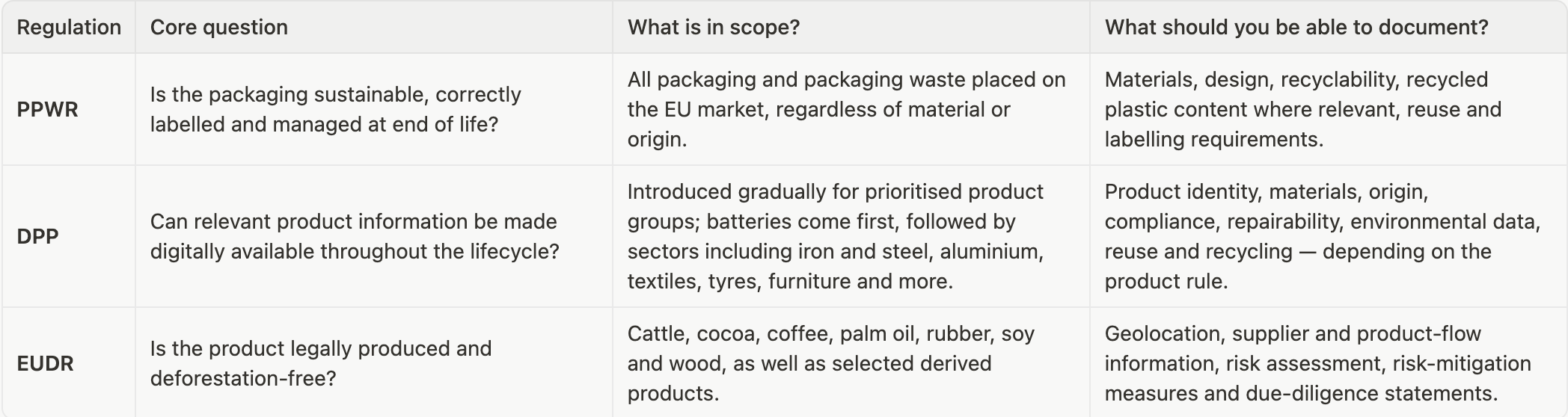
The Packaging and Packaging Waste Regulation, PPWR (Regulation (EU) 2025/40), entered into force on 11 February 2025 and generally applies from 12 August 2026. It covers the full packaging lifecycle — from design to waste management — and applies to all packaging placed on the EU market.
The Digital Product Passport (DPP) is the digital infrastructure that will progressively make relevant product information more accessible and standardised. It is rooted in the Ecodesign for Sustainable Products Regulation (ESPR), while detailed data requirements will be set product group by product group through delegated acts and other applicable EU legislation.
The EU Deforestation Regulation (EUDR) is different again: it is a due-diligence and documentation obligation for deforestation-relevant commodities. Operators and traders need to be able to demonstrate that relevant products do not originate from recently deforested land and have not contributed to forest degradation.
Start by clarifying your role
“How do we become compliant?” is not a single question until you know the role your business plays. A manufacturer, importer, brand owner, distributor and retailer can have different obligations even when they handle the same product.
Start by mapping four elements: the products you place on the EU/EEA market, the packaging that accompanies them, the commodities and product groups you procure, and your role in each product flow. This creates a practical regulatory map and prevents IT, packaging, procurement and sustainability teams from working from separate, incomplete versions of the truth.
A useful starting point is to select one product family and follow it from raw material to customer. Identify which internal systems and external suppliers hold the data at each stage. This will quickly reveal whether the real bottleneck is an unlinked batch, an unstructured supplier certificate or an unidentifiable pallet — rather than the QR code itself.
What do we need to print on products and packaging?
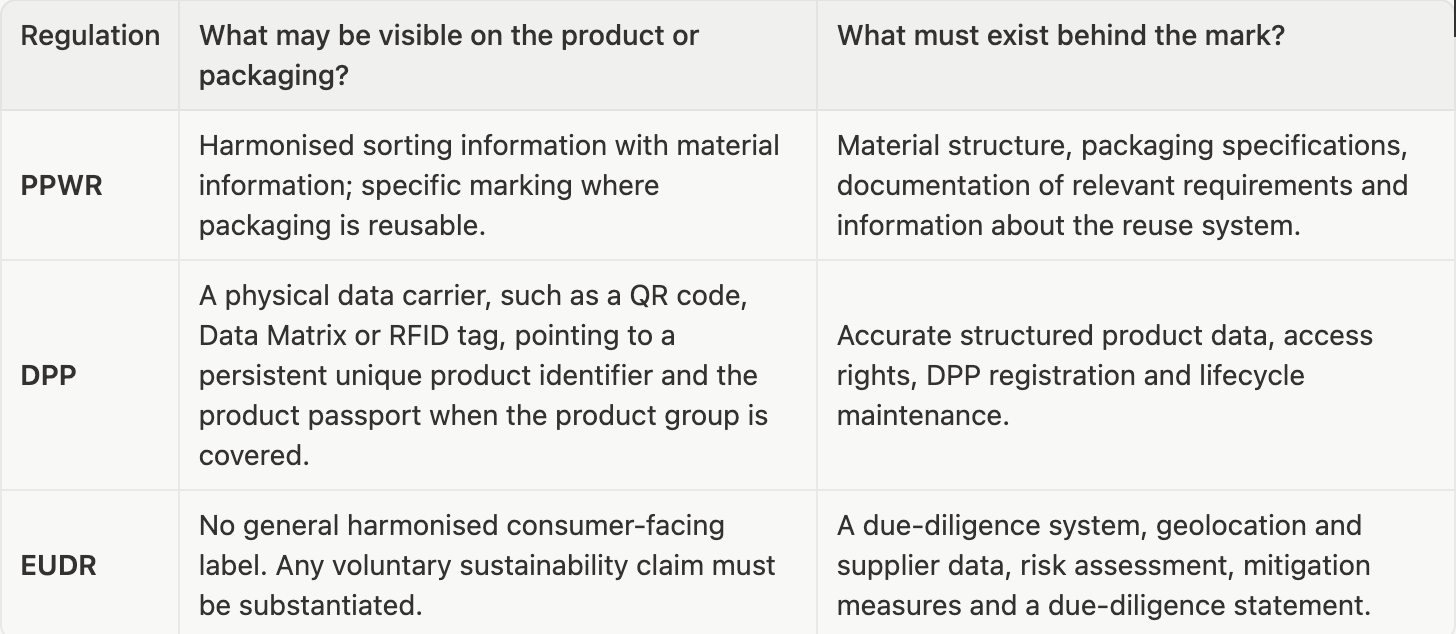
This is one of the most practical questions, and it is also an area where many businesses make the mistake of waiting for one universal label. There is no single PPWR, DPP or EUDR mark that solves everything. Before ordering new artwork, determine which physical or digital information is actually relevant to the particular product and market.
PPWR: harmonised packaging labelling will be phased in
Article 12 of PPWR establishes the basis for a harmonised labelling system for packaging. The European Commission states that the system will apply from 2028 to facilitate waste sorting. Its core purpose is to communicate packaging-material information in a consistent and understandable way. Details of symbols, formats, exemptions and transition rules must always be assessed together with the relevant implementing rules for the packaging in question.
For reusable packaging, labelling and digital information about reuse systems and collection points will be particularly relevant. PPWR allows standardised, open digital data carriers — such as a QR code — where that additional information is to be provided. Businesses using packaging that contains substances of concern should likewise follow the product-specific rules on digital information and marking closely.
In practice, this means that packaging teams should already have control over material structures, packaging components, recyclability and requirements that may be relevant for each packaging type. Do not replace existing GS1 barcodes indiscriminately. Instead, plan how any necessary PPWR marking and digital data carrier can coexist with GTINs, logistics labels and future DPP requirements.
DPP: a data carrier links the product to its passport
When a product is subject to DPP requirements, a digital data carrier — such as a QR code, Data Matrix or RFID tag — links the physical product to a persistent, unique product identifier and the passport. The carrier must be physically accessible on the product, its packaging or accompanying documentation in accordance with the relevant product rule. The passport is registered with a unique URI in the EU DPP Registry, while detailed information is held by the economic operator or a service provider.
The symbol itself is not the decisive factor. Compliance depends on the identity and data behind the symbol being correct, available and governed over time. A well-designed QR code without a correct product identifier, appropriate access rights or maintained data does not create compliance.
EUDR: documentation in the system, not a general consumer label
EUDR is primarily a due-diligence and documentation obligation. Businesses normally do not need to create a separate “EUDR label” for every product. Instead, where goods are in scope, they must document legality, deforestation-free status and relevant traceability, and submit a due-diligence statement in the EU Information System before a product is placed on the market or exported.
In practice, the due-diligence process consists of three steps: collecting information, assessing risk and — where risk is not negligible — taking risk-mitigation measures. The information includes the product, quantity, supplier, country of production and geolocation of relevant production plots. Due-diligence documentation must be retained for five years.
In short: do not print anything before you understand which regulated information and identity the mark is meant to represent. Start with the data foundation; then choose the right carrier and design.
How does GS1 Digital Link work?
GS1 Digital Link makes a GS1 identifier web-enabled. Instead of a code containing only a number, it becomes a standardised web link, for example:
https://id.yourdomain.com/01/07012345678903/21/ABC123
In this example, 01 identifies a GTIN — the product identity — while 21 identifies the serial number. A QR code containing this link can be read by a mobile phone, a point-of-sale system or a logistics application, but each can receive different information according to its role and context.
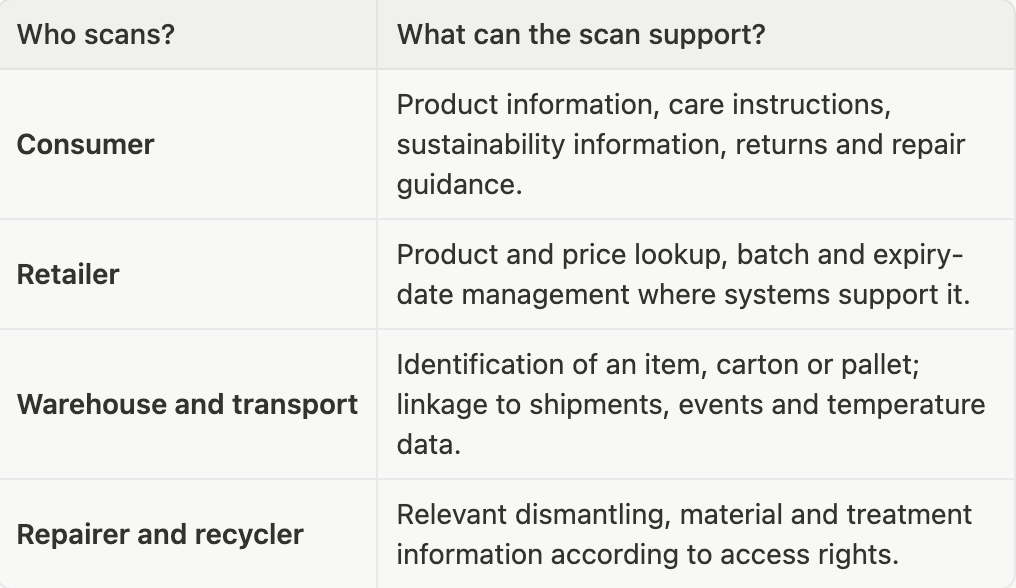
GS1 Digital Link is therefore a powerful tool for connecting one physical product to multiple digital purposes. GS1 describes how a single 2D data carrier, using structured GS1 identifiers and a web-enabled link, can support B2B, B2G and B2C needs at the same time.
However, precision matters: GS1 Digital Link is an open standard and a strategic implementation choice; it is not automatically mandatory in every PPWR, DPP or EUDR scenario. When EU or sector-specific rules require a digital data carrier, the business must check the applicable legal act, standards and access requirements before selecting a final solution.
The advantage of starting with GS1 identity — GTIN for products, GLN for parties and locations, SSCC for logistics units and GRAI for returnable assets — is that you avoid creating an isolated QR solution that later fails to work with ERP, WMS, EDI, trading partners or the DPP Registry.
Timeline: what happens when?
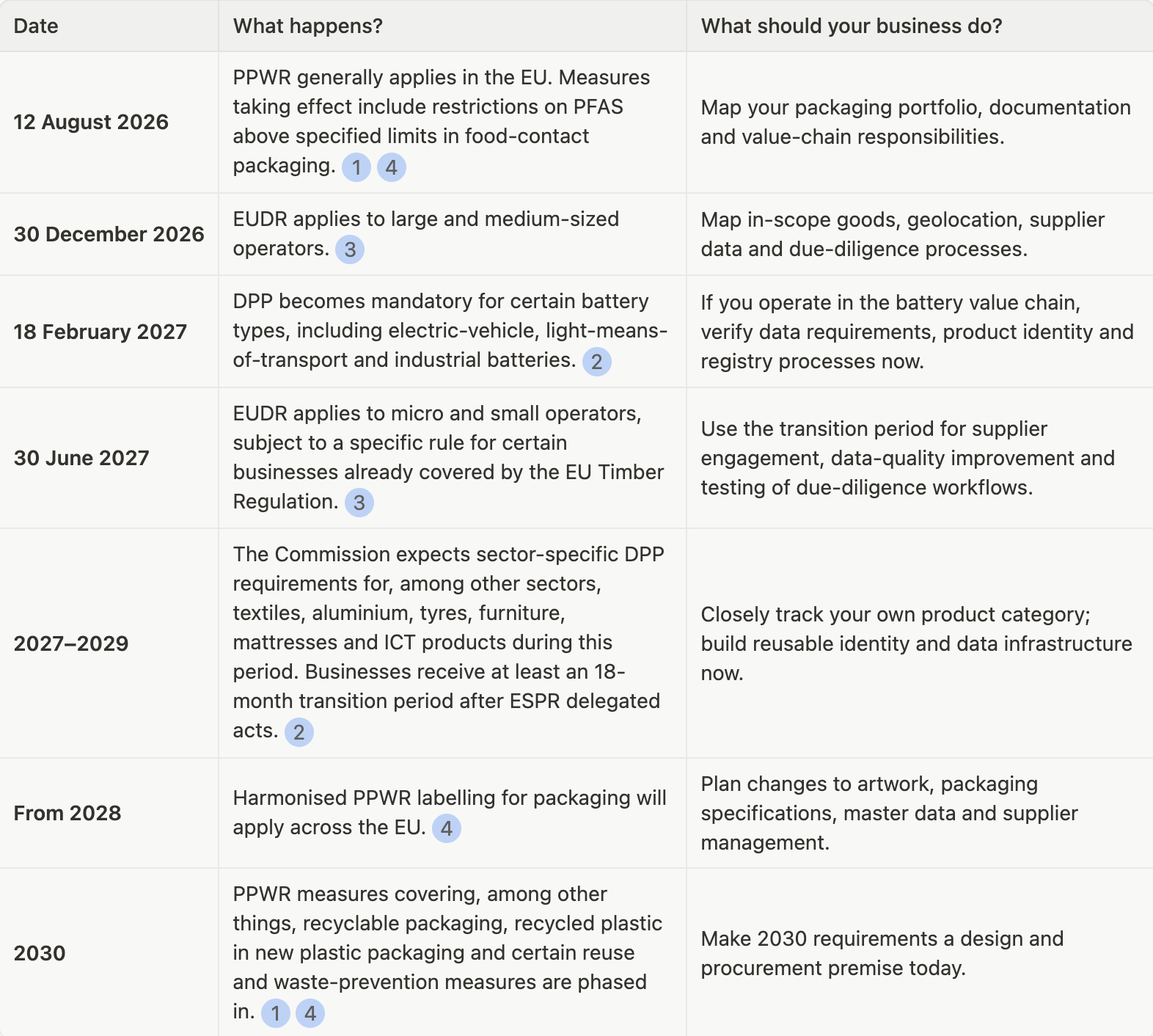
The dates are real, but implementation is phased. Do not build your roadmap as if every product will receive a DPP at the same time, or as if all PPWR labelling requirements take effect on day one.
A practical six-step plan
The regulations differ, but the first actions businesses should take overlap significantly. This is a useful sequence for most organisations.
1. Establish cross-functional ownership. DPP and PPWR cannot be owned by IT alone. Assemble a small team from product, packaging, procurement, quality, sustainability, legal and IT. Decide who owns each data category and who approves changes.
2. Map products, packaging and commodities. Connect products to master data, packaging components, suppliers, production sites and markets. Flag where PPWR, DPP-priority product groups or EUDR commodities apply.
3. Build an identity strategy. Ensure each product variant has the correct GTIN, locations have a clear identity — GLN where relevant — and pallets or shipments can be linked to an SSCC. Define when batch and serial numbers are required.
4. Make documentation machine-readable. Move from PDFs in email inboxes and free text in spreadsheets to structured data with source, date, accountable owner and version control. This is essential for DPP, EUDR and efficient PPWR reporting.
5. Pilot one flow. Choose one product family or one packaging solution. Test how GS1 Digital Link, QR codes or RFID can connect the product, package, shipment and evidence. Measure data quality and process errors before scaling.
6. Follow the legal acts, not just the headlines. Product-specific DPP requirements and PPWR implementing rules will develop over time. Monitor official EU sources, industry bodies and competent professional advice, and refresh your roadmap at least quarterly.
From uncertainty to competitive advantage
Businesses that start now gain more than regulatory assurance. They gain better product-data control, less manual work, faster handling of deviations and a stronger basis for documenting sustainability to customers and authorities.
It is not the QR code that makes a business ready for PPWR, DPP and EUDR. It is a shared, reliable model for product identity and data. QR codes, RFID and GS1 Digital Link are then the tools that make that information available where value is created — in the factory, warehouse, shop, repair network and at end of life.
Invig AS helps businesses turn these requirements into solutions that work in practice: from GS1 identity and digital data carriers to RFID, IoT data and traceability across the value chain.
References
[1] European Commission: Packaging waste — PPWR
[2] European Commission: Digital Product Passport
[3] European Commission: Regulation on deforestation-free products (EUDR)
[4] European Commission: New EU packaging rules start to apply
[5] European Commission: Understand due diligence under the EUDR
[6] GS1 Europe: GS1 Standards enabling the EU digital product passport (PDF)
Last updated 20 August 2026. Regulations and product-specific implementing rules may change. Invig AS recommends obtaining legal advice on the specific obligations that apply to your business.